What is a SaaS platform, and what does VirtuoLab build?
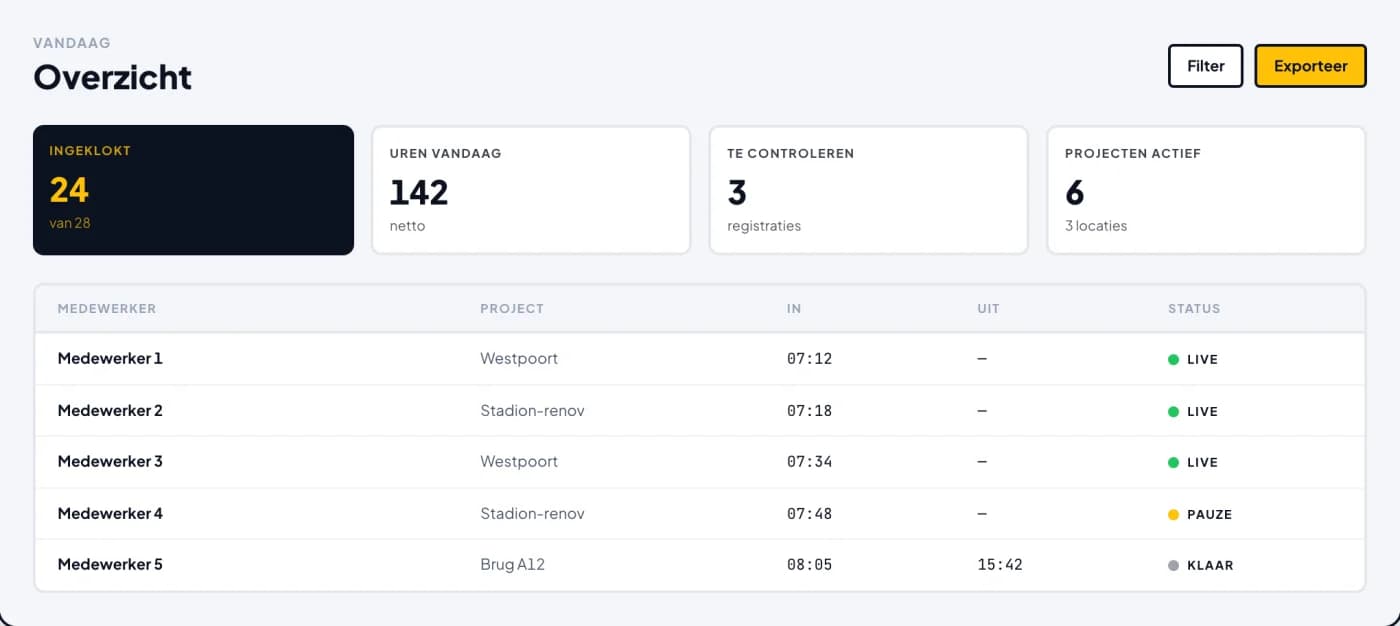
A SaaS platform is software which customers use in the browser for a recurring subscription fee, instead of buying and installing a licence. Well-known examples are Slack, Notion and Microsoft 365. VirtuoLab builds SaaS products for founders and businesses who want to sell software as a product. A SaaS platform is more than the core feature alone, and the basics come in four parts. First, sign-up and login, with user roles inside every customer account. Second, multi-tenant data separation, so each customer account sees only its own data. Third, subscriptions and payments through a provider such as Stripe or Mollie. Finally, an admin environment where the owner manages customers, plans and usage, plus automatic emails for invitations, password resets and receipts. The full product is built by VirtuoLab with Next.js, Node.js and PostgreSQL. For example, a planning tool sold to 200 businesses runs on one shared platform with separate data per customer. The CloudFlow demo on virtuolab.dev shows such an admin dashboard with simulated data.
What does it cost to build a SaaS platform in 2026?
A SaaS MVP from VirtuoLab costs from €15,000 in 2026, and a complete SaaS platform costs €30,000 to €80,000. Every amount is an indication, and VirtuoLab sets the exact price after a free intake call, before development starts. An MVP contains the core feature, sign-up and login, one or two subscription plans and online payments. The complete platform adds team accounts with roles, an admin environment, reports, integrations and often an API for customers. Several factors drive the price. First, the number of features in the core product. Second, the pricing model: a flat monthly fee is simpler than per-seat pricing, usage-based pricing or a free trial. Third, integrations with Exact Online, a CRM or other tools. Finally, the demands on security and scale, such as single sign-on for business customers. In practice, a narrow MVP for the first 10 customers is a cheaper and safer start than a full platform on day one.
How long does it take to develop a SaaS platform with VirtuoLab?
A complex web app or SaaS platform takes 12 to 24 weeks at VirtuoLab. A smaller first version is faster: an MVP web app with a login takes 6 to 10 weeks. Every SaaS project follows four steps. Step 1 is the intake and scope: a free call about the customer problem, the market and the pricing model. Step 2 is design and validation: the screens, the data model and the separation between customer accounts are designed by VirtuoLab. You approve the design before building starts. Step 3 is building and testing in short sprints, with a working demo after every sprint, so you can show progress to a pilot group of 5 customers early. Step 4 is the launch and support, with Stripe or Mollie switched to live payments and further development based on real usage. In practice, the pricing model deserves attention early. A later switch from per-user pricing to usage-based pricing touches many parts of the code, once 100 customers pay per seat.
Which technology does VirtuoLab use for SaaS, and how does the platform scale?
Multi-tenancy means one installation of the software serves many customer accounts, with strict separation of data per account. VirtuoLab builds SaaS platforms with Next.js and TypeScript for the interface, Node.js for the server logic and PostgreSQL as the database. A proven approach in PostgreSQL is to give every record the ID of the customer account. Row-level security then blocks access to records of other accounts. The separation matters: broken access control ranks first in the OWASP Top 10:2025 and appeared in 100% of the applications tested, according to OWASP. Payments run through Stripe or Mollie, for example, with webhooks which update the subscription status automatically. Scaling happens step by step. Step 1 is a single server with a single database, which handles the early stage well. Step 2 adds extra Docker containers and caching to absorb growth in the number of users. Finally, heavy background jobs, such as reports or imports, move to separate workers. Expensive infrastructure therefore only arrives once the platform has paying customers.
Why build your SaaS platform with VirtuoLab instead of a larger agency?
VirtuoLab is a one-person software agency, which suits founders who want one technical partner instead of a chain of contacts. First, you work directly with Mustafa Kose, who writes the code and knows every part of the platform. Second, a fixed price upfront gives founders a clear budget for the runway. Runway matters: running out of capital appeared in 70% of the startup shutdowns in a 2026 CB Insights report. Third, the source code and the data belong to you after delivery. For a SaaS company, the code is the product, so ownership counts once investors or buyers look at the business. Finally, short sprints with demos keep the product visible during the build. There are honest limits too. In practice, a larger agency fits better when a platform needs a product team of 5 people from day one, or round-the-clock support. VirtuoLab is available Monday to Friday from 09:00 to 18:00. Once the platform grows, client-owned code makes a handover to an in-house team simple.
Who is SaaS development by VirtuoLab a good fit for?
SaaS development by VirtuoLab is a good fit for founders with a validated idea. The service also suits businesses which want to turn in-house expertise into a software product. Validated means at least a waiting list, a few pilot customers or paying users of a manual version. For example, a planning tool for one industry fits, and so does a client portal sold to companies in the same sector. An internal tool which other businesses ask for can also grow into a SaaS product. The budget for an MVP starts at €15,000 in 2026. VirtuoLab works with founders across the Netherlands, Belgium and Germany, online or on location in the Drechtsteden and Rotterdam. Without any validation, a full SaaS build comes too early. A landing page built with Next.js and a waiting list costs €1,000 to €3,000, takes 1 to 2 weeks and shows whether 100 people actually sign up. When demand is still unclear, VirtuoLab recommends the cheaper first step in the intake call.