Back to projects
SecurityVirtuoLab's own product

CSBI

Software for security research

  • Tests only with authorisation and within scope
  • Connected to Kali Linux
  • Audit log and SHA-256 evidence
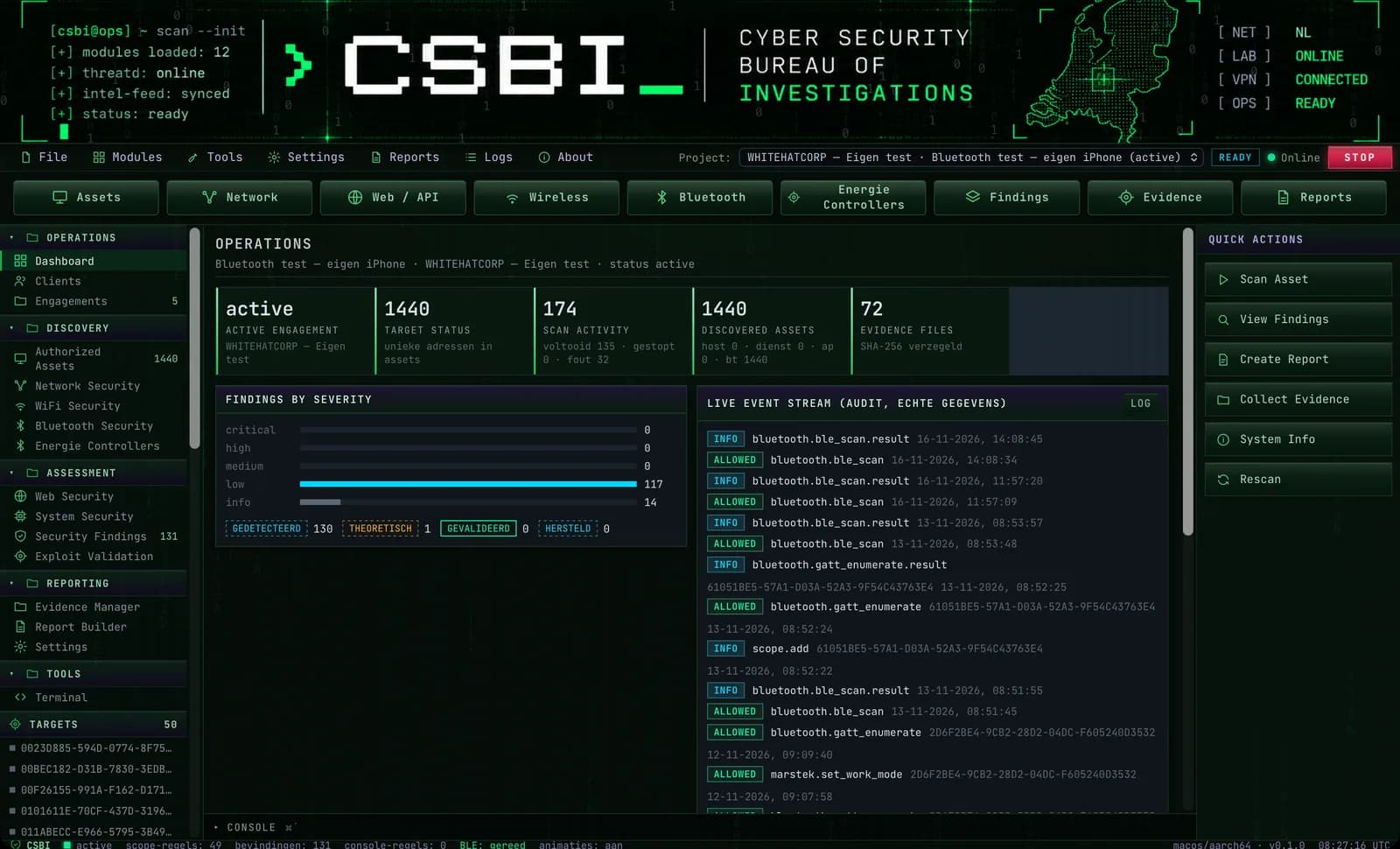
The dashboard: the active engagement, authorised targets, scans, findings by severity and a live audit log of every action.

From the software

Recordings and screens from CSBI itself.

The dashboard: the active engagement, authorised targets, scans, findings by severity and a live audit log of every action.
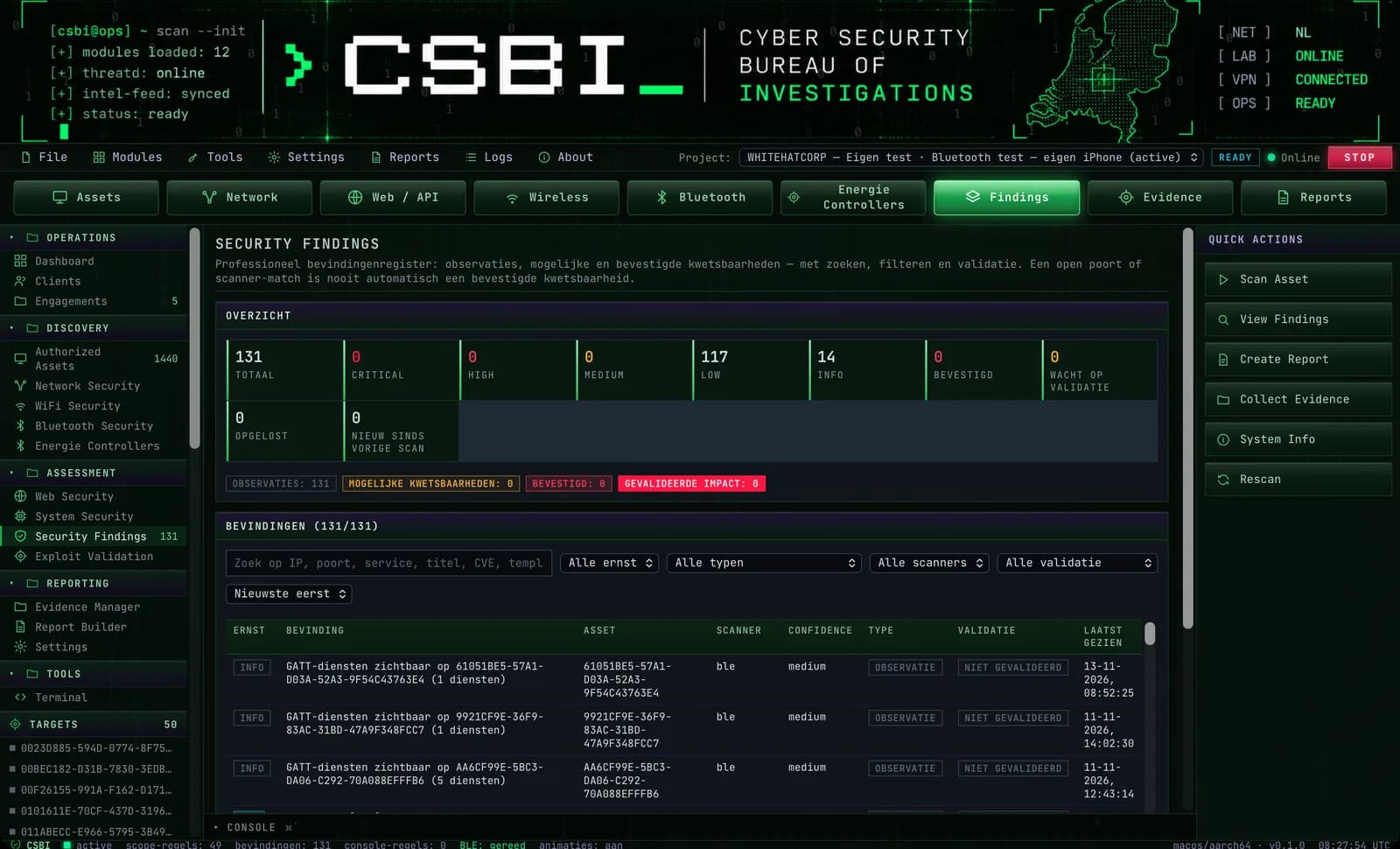
The findings register: every finding with severity, scanner, confidence and validation status. An open port is an observation, not a confirmed vulnerability.
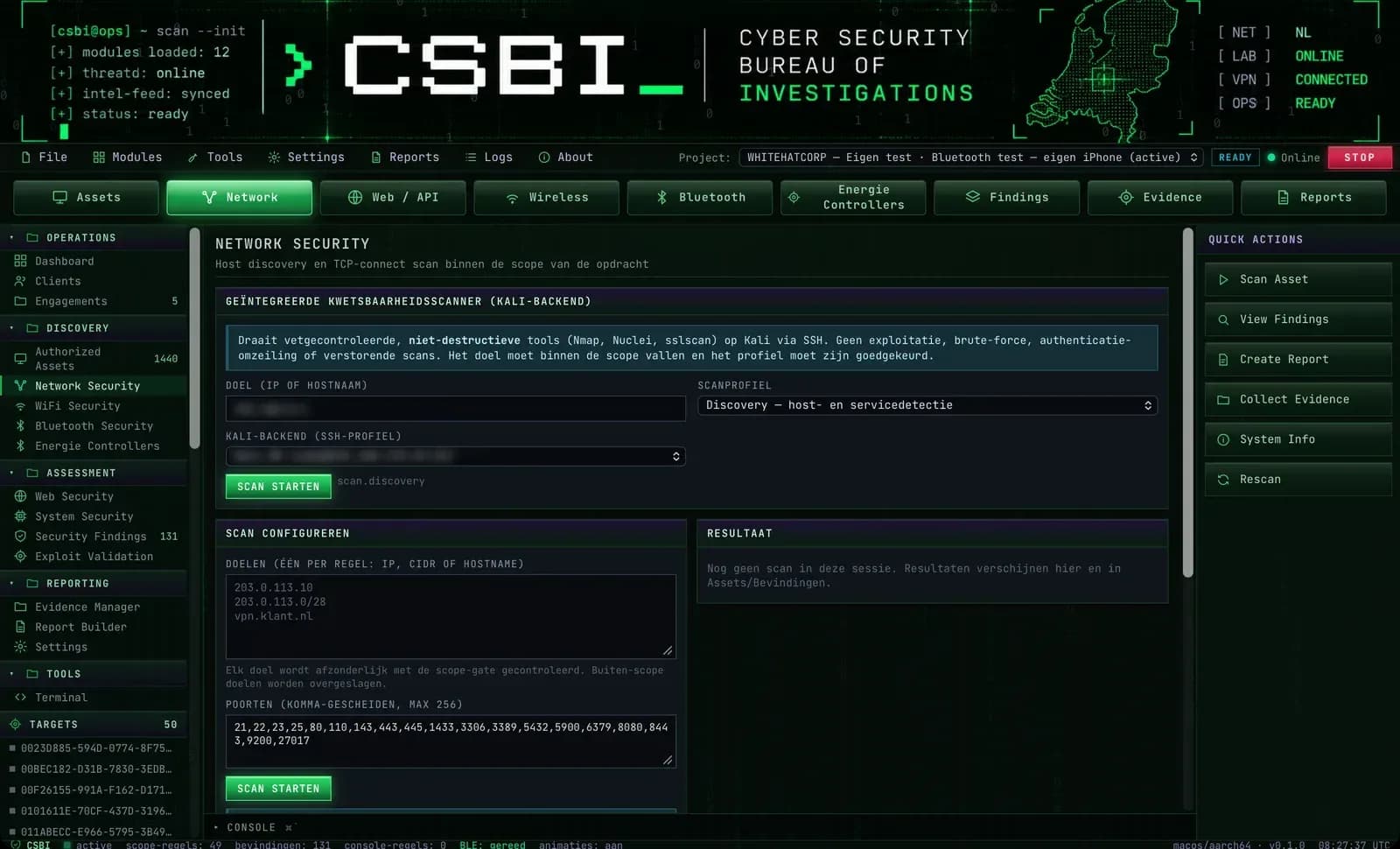
The vulnerability scanner drives Nmap, Nuclei and sslscan on a Kali Linux machine over SSH, non-destructive only and only within scope.
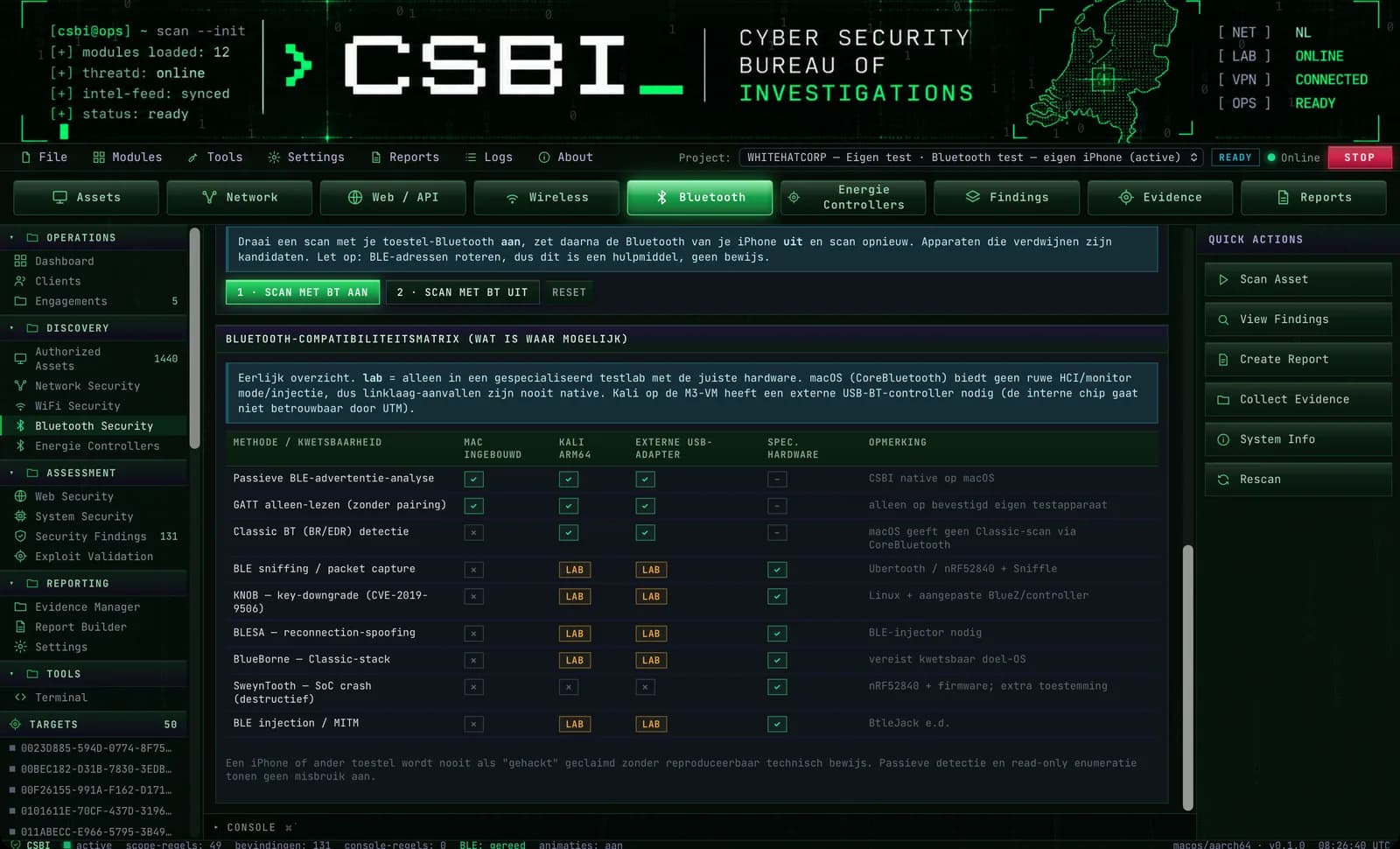
Bluetooth security with an honest matrix: what the Mac can do itself, what Kali can do and what is only possible in a lab with special hardware.
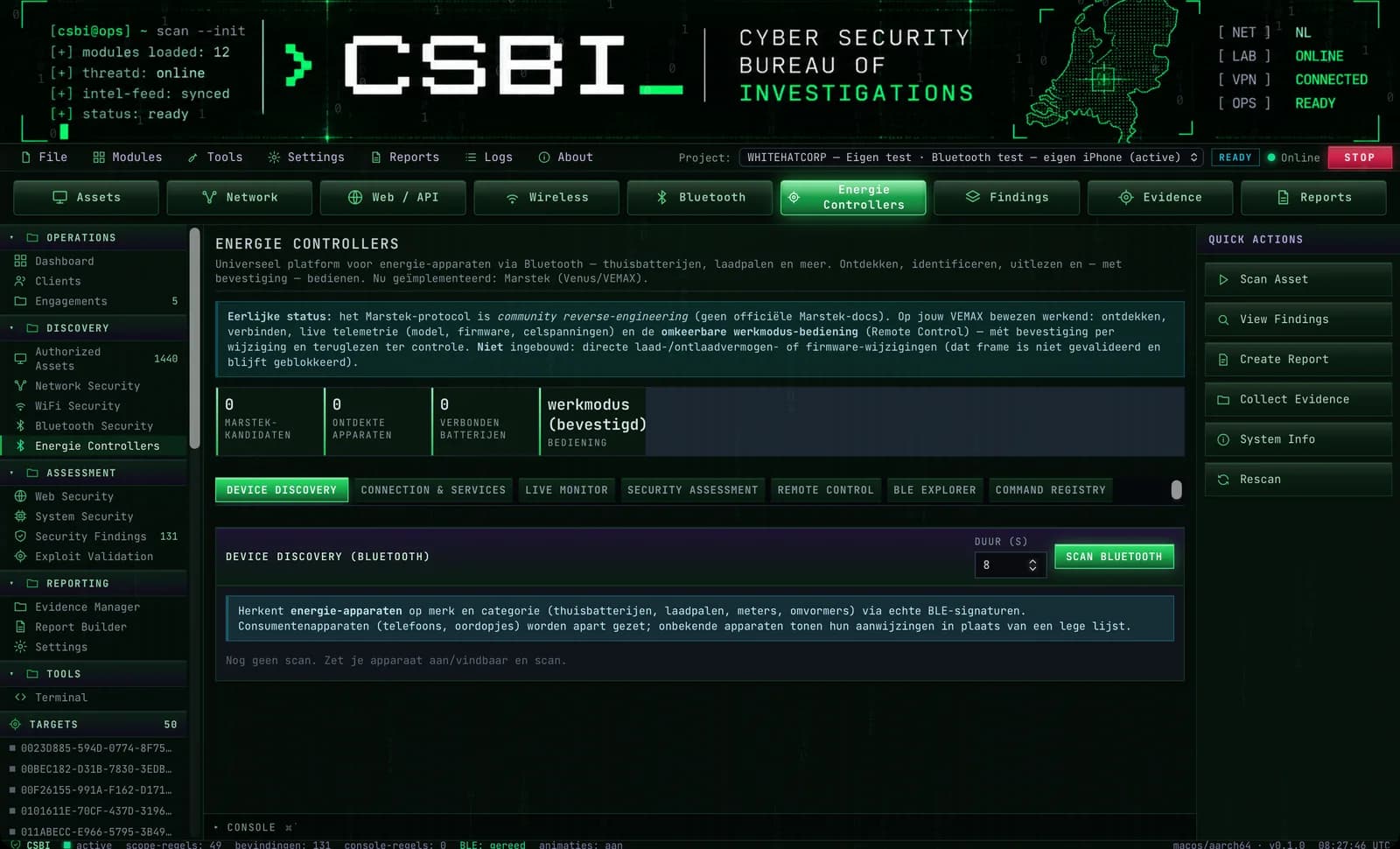
Energy controllers: recognising home batteries, chargers and meters over Bluetooth, with an honest status per model and every command in the audit log.
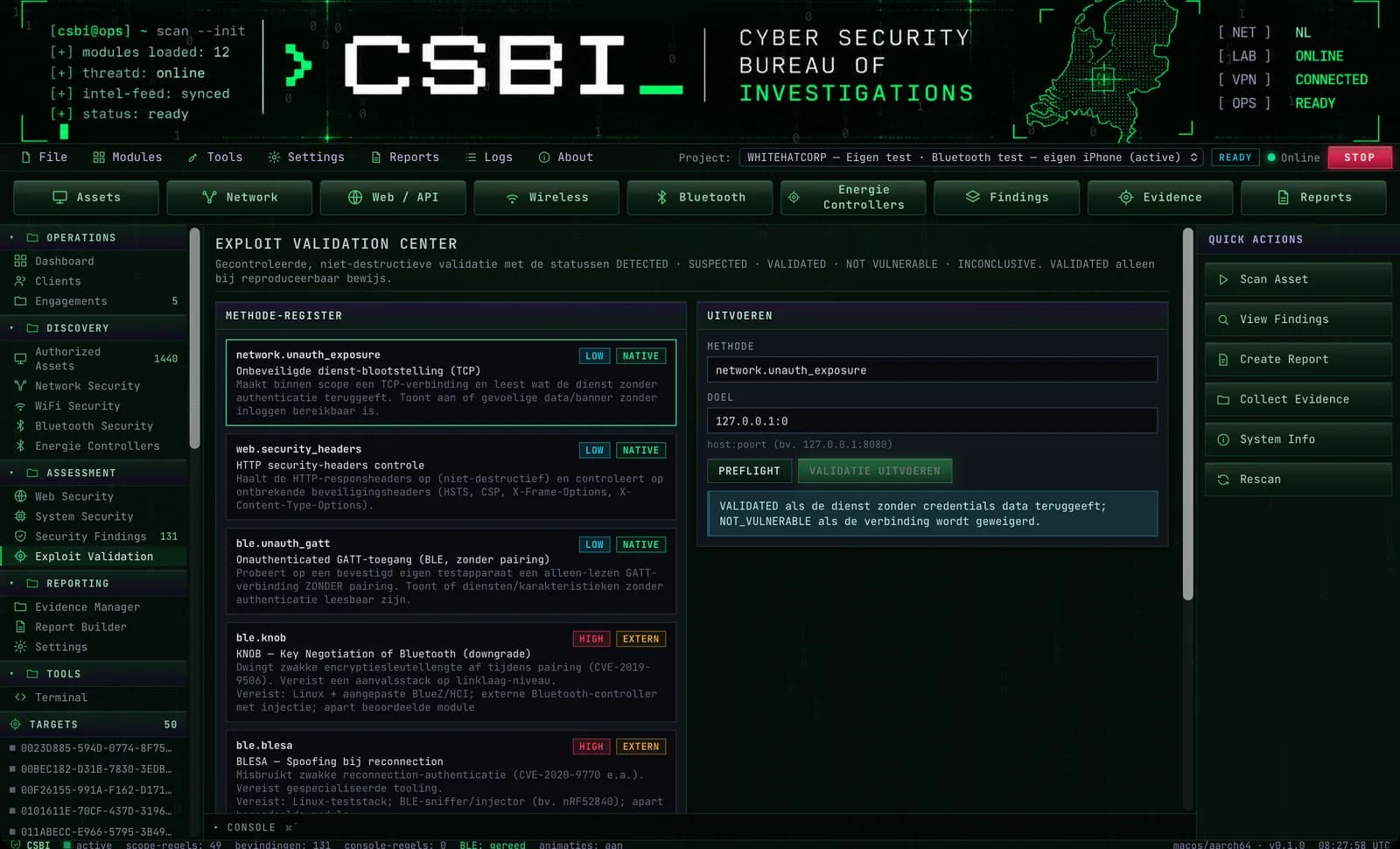
The validation centre: a finding only becomes Validated with reproducible technical evidence. Without evidence it stays Detected or Theoretical.
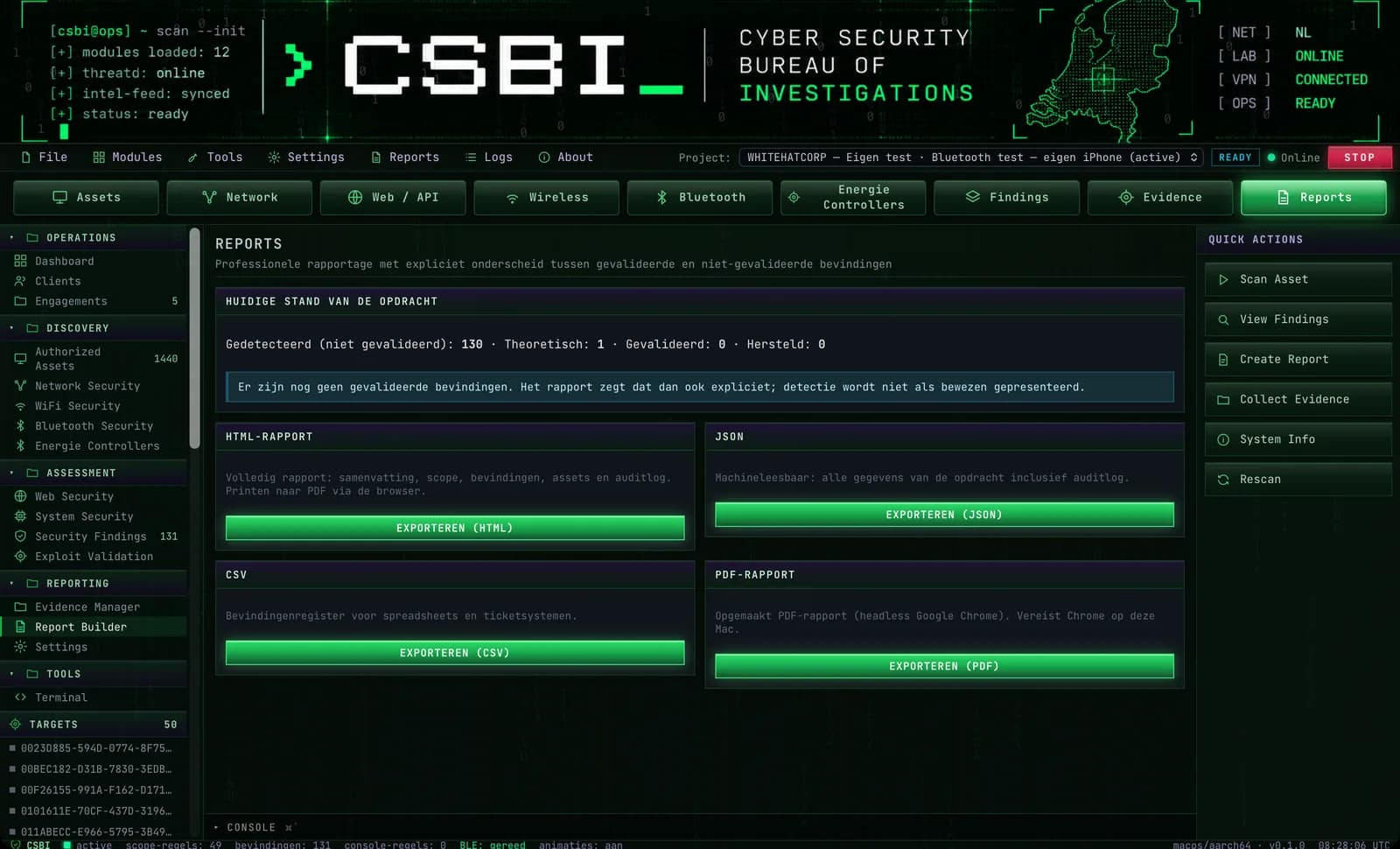
Reports in HTML, PDF, JSON and CSV, with a clear distinction between validated and unvalidated findings.

About CSBI

Type
VirtuoLab's own product
Platform
macOS
Technologies
TauriRustReactTypeScriptSQLiteKali Linux

CSBI, short for Cyber Security Bureau of Investigations, is software VirtuoLab built for its own security research. It is a desktop app for macOS that lets a security researcher examine networks, Wi-Fi, Bluetooth devices and energy equipment such as home batteries. Every test belongs to an engagement with recorded authorisation and a scope: anything outside that scope, CSBI refuses. Network scans run on a Kali Linux machine, with fixed, non-destructive tools such as Nmap, Nuclei and sslscan. Every action goes into an audit log that cannot be changed afterwards, and evidence gets a SHA-256 hash. A finding is only called validated with reproducible technical evidence. CSBI is not for sale: VirtuoLab uses it for its own research. The screens on this page come from CSBI itself, from tests on VirtuoLab's own equipment.

CybersecurityPenetration testingKali LinuxDesktop app
01

What does CSBI do?

CSBI is a workspace for security research that keeps every step of a test in one place. First, a researcher records an engagement: who gave authorisation, in writing, verbally or for an own test lab, and which addresses, networks or devices are in scope. Second, CSBI runs the tests. Network scans run on Kali Linux with Nmap, Nuclei and sslscan. CSBI reads Wi-Fi and Bluetooth directly through macOS. The Energy Controllers module recognises home batteries, EV chargers and meters over Bluetooth. Third, all results go into one findings register, with severity, scanner and confidence. Finally, CSBI produces a report in HTML, PDF, JSON or CSV. The dashboard shows the active engagement, findings by severity and a live log of every action.

02

Why did VirtuoLab build its own security software?

VirtuoLab built CSBI because separate tools do not guard a boundary. Nmap scans any address you type, even one that is not part of the engagement. CSBI checks on every action whether the engagement is active, whether the method is approved and whether the target is in scope. If not, CSBI refuses the action and records the refusal. CSBI also separates strictly what a scanner sees from what is proven. An open port is an observation, a Nuclei alert is a potential vulnerability, and only reproducible technical evidence makes a finding validated. A report shows that difference, so a client knows what has actually been demonstrated. Mustafa Kose, VirtuoLab's founder, is a Certified Ethical Hacker (CEH) with EC-Council and uses CSBI for his own research.

03

How is CSBI built?

CSBI is a desktop app built with Tauri 2: the screens are React and TypeScript, the core is written in Rust. All data is stored locally in an SQLite database, encrypted with AES-256-GCM. The audit log can only grow: the database refuses to change or delete entries. Network scans run on a separate Kali Linux machine, which CSBI controls over SSH with a fixed list of allowed commands. Exploitation, brute force and scans that could disrupt systems are not on that list. Wi-Fi and Bluetooth use the system functions of macOS, and CSBI states honestly what macOS does not allow, such as monitor mode or intercepting Bluetooth traffic. The Rust core has its own automated tests. CSBI runs as version 0.1 on a Mac with Apple silicon. VirtuoLab uses the same approach, with permissions per action and a complete audit log, in custom software for clients.